


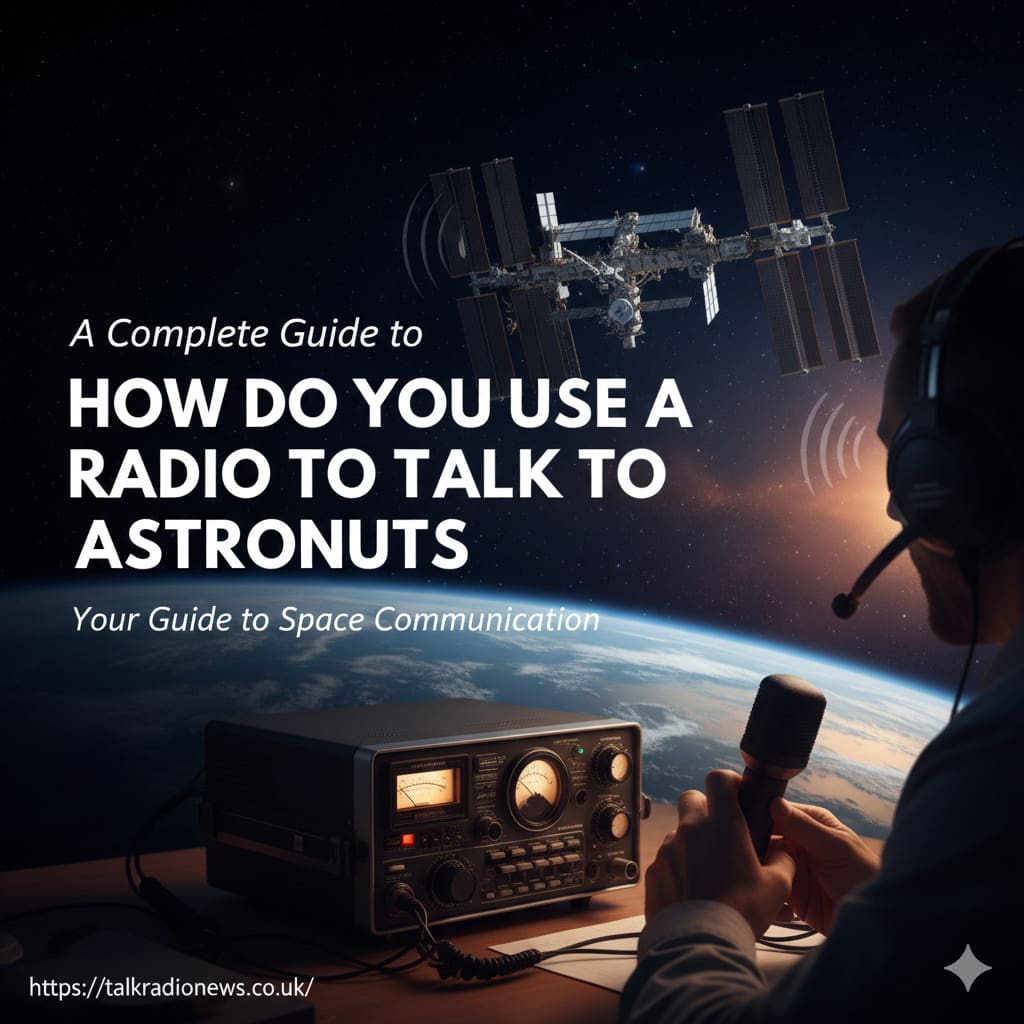
Have you ever looked up at the night sky and wondered what it would be like to speak with someone orbiting high above Earth? For many, talking to an astronaut is a lifelong dream. It might sound like something straight out of a science fiction movie, but it’s more achievable than you think. The key lies in a hobby that has connected people for over a century: amateur radio. This guide will walk you through the fascinating process of how do you use a radio to talk to astronauts aboard the International Space Station (ISS). It’s a journey that combines technology, patience, and a little bit of luck.
- Key Takeaways
- Understanding the Basics of Space Communication
- Gearing Up: What You’ll Need
- Getting Your Amateur Radio License
- Essential Radio Equipment
- Equipment Comparison: Handheld vs. Base Station
- The Process: How Do You Use a Radio to Talk to Astronauts
- Conclusion: A Connection Beyond Earth
- Frequently Asked Questions (FAQ)
Key Takeaways
- Amateur Radio is Essential: You need an amateur radio license (often called a “ham radio” license) to legally transmit signals to the ISS.
- Specialized Equipment is Required: A 2-meter band VHF transceiver and a directional antenna are necessary to make contact.
- Timing is Everything: You can only talk to astronauts when the ISS is passing directly overhead, which is a window of about 10 minutes.
- ARISS is Your Go-To Resource: The Amateur Radio on the International Space Station (ARISS) program coordinates most contacts and provides crucial information.
- Patience is a Virtue: Making a successful contact requires careful planning, practice, and persistence.
Understanding the Basics of Space Communication
Communicating across the vastness of space isn’t as simple as making a phone call. Radio waves are the carrier pigeons of the cosmos, but they face challenges like the Earth’s atmosphere, solar radiation, and the sheer distance involved. Astronauts on the ISS use specialized radio systems to talk with mission control, their families, and amateur radio operators on the ground.
These communications happen on specific frequencies. Think of it like tuning your car radio to your favorite station. To talk to the ISS, you need to know their “station” number. The ISS orbits Earth at about 17,500 miles per hour, completing a full circle in roughly 90 minutes. This means it’s constantly moving, making it a moving target for your radio signal. This is why timing and tracking are so critical for anyone wanting to learn how do you use a radio to talk to astronauts.
What is Amateur Radio?
Amateur radio, or ham radio, is a popular hobby and service that brings people, electronics, and communication together. Licensed operators use radio equipment to communicate with others across town, around the world, or even into space. Unlike a CB radio or a walkie-talkie, you need a license from the Federal Communications Commission (FCC) in the United States to operate a ham radio. This license ensures you understand the rules, etiquette, and technical principles of radio operation. It’s this community of licensed operators that gets the unique chance to speak directly with astronauts. For more insights into the world of radio, you can explore resources like talkradionews.
The Role of ARISS
The Amateur Radio on the International Space Station (ARISS) program is a cooperative venture between NASA, other international space agencies, and volunteer amateur radio organizations worldwide. Its primary mission is to inspire students to pursue careers in science, technology, engineering, and math (STEM) by providing opportunities for them to speak with orbiting crew members. ARISS coordinates scheduled contacts for schools and educational groups, but it also maintains the radio equipment on the ISS that individual ham operators can use for unscheduled contacts. They are the gatekeepers and facilitators for this incredible experience.
Gearing Up: What You’ll Need
Making contact with the ISS requires more than just a standard walkie-talkie. You’ll need specific equipment capable of reaching a target moving at incredible speeds more than 250 miles above your head.
Getting Your Amateur Radio License
The first and most important step is getting your license. In the US, the FCC issues three levels of licenses: Technician, General, and Amateur Extra.
- Technician License: This is the entry-level license and is all you need to talk to the ISS. It grants you operating privileges on the VHF and UHF bands used for space communications.
- General License: This license opens up more frequencies, allowing for long-distance, worldwide communication.
- Amateur Extra License: This is the highest level, giving you access to all amateur radio bands.
To get your Technician license, you must pass a 35-question multiple-choice exam. Many local clubs offer weekend classes and testing sessions to help you prepare.
Essential Radio Equipment
Once you’re licensed, it’s time to build your ground station. Here’s a breakdown of the necessary gear:
- VHF Transceiver: You need a radio that can transmit and receive on the 2-meter band (specifically 144-148 MHz). A simple handheld transceiver (HT) can sometimes work, but a more powerful mobile or base station radio is recommended for better results.
- Directional Antenna: Since the ISS is a moving target, you need an antenna you can point directly at it. A handheld Yagi antenna is a popular and effective choice. It looks a bit like an old-school TV antenna and is highly directional.
- Tracking Software: You need to know exactly when the ISS will be in your sky and where to point your antenna. Free websites and smartphone apps like Heavens-Above can provide precise pass predictions for your location.
Equipment Comparison: Handheld vs. Base Station
Feature | Handheld Transceiver (HT) | Base Station Radio |
|---|---|---|
Power Output | Low (5-8 watts) | High (25-100 watts) |
Portability | Excellent | Fixed, not portable |
Antenna | Small, inefficient “rubber duck” | Requires external antenna |
Cost | Less expensive ($50 – $200) | More expensive ($200 – $1000+) |
Success Rate | Lower, requires a perfect pass | Higher, more reliable signal |
Best For | Beginners, portable operation | Serious hobbyists, home stations |
While an HT is a great starting point, investing in a base station and a good quality Yagi antenna will significantly increase your chances of making a successful contact.
The Process: How Do You Use a Radio to Talk to Astronauts
With your license and equipment ready, it’s time to put it all together. The process requires careful planning and quick execution during the short window of opportunity.
Step 1: Track the ISS
First, use your tracking software to find the upcoming ISS passes over your location. Look for high-elevation passes—those where the station will pass almost directly overhead (70-90 degrees elevation). These passes provide the longest and strongest signal. Your software will tell you the exact time the pass starts, its maximum elevation, and when it ends.
Step 2: Find the Right Frequency
ARISS operates on very specific frequencies. You will need to program these into your radio. The standard voice downlink frequency (what you listen for) is 145.800 MHz. The uplink frequency (what you transmit on) can vary to avoid interference, so you must check the official ARISS frequency list for the correct one to use. This is a crucial step in learning how do you use a radio to talk to astronauts.
Common ARISS Frequencies
- Voice Downlink: 145.800 MHz (Worldwide)
- Voice Uplink: 144.490 MHz (for North/South America)
- Packet Radio Downlink: 145.825 MHz
Step 3: Making the Call
As the ISS rises above the horizon, begin listening on the downlink frequency. You might hear static at first, but as it gets closer, you may hear other hams trying to make contact or even the voice of an astronaut.
When you’re ready to transmit, keep your call short and clear.
- State their call sign (NA1SS) and then your own call sign phonetically. For example: “November Alpha One Sierra Sierra, this is Whiskey One Alpha Whiskey.”
- Listen for a response. The astronaut is likely very busy and talking to many people.
- If they respond to you, be ready! Keep your exchange brief and to the point. Ask a quick question or simply say hello and thank them.
The entire pass only lasts about 10 minutes, and you only have a few minutes of good, clear signal at the peak. You have to be patient and persistent.
Conclusion: A Connection Beyond Earth
Learning how do you use a radio to talk to astronauts is an incredible journey that blends science, technology, and a sense of adventure. It’s a hobby that connects you not just with people across the globe, but with the handful of humans living and working among the stars. While it requires dedication to get a license and the right equipment, the thrill of hearing a voice respond from the International Space Station is an unmatched experience. It’s a powerful reminder of what humanity can achieve and a personal connection to the final frontier. So, start studying for your license, track the skies, and get ready to make a call that is truly out of this world.
Frequently Asked Questions (FAQ)
Q1: Do I really need a license to talk to astronauts?
Yes, an amateur radio license is required by law to transmit on the frequencies used by the ISS. You can listen without a license, but you cannot transmit.
Q2: How often are astronauts available to talk?
It varies. Astronauts who are licensed ham operators can use the radio during their personal time. Availability depends on their workload, sleep schedule, and interest. ARISS also schedules regular contacts with schools, which you can listen in on.
Q3: What are my chances of actually making contact?
It can be challenging. You are competing with many other operators during a very short time window. However, with persistence, the right equipment, and a bit of luck, it is very possible.
Q4: Can I use my phone to talk to astronauts?
No, you cannot use a standard cell phone. Communication requires a VHF radio transceiver capable of reaching the ISS on the designated amateur radio frequencies.
Q5: What kind of question should I ask an astronaut?
If you make contact, keep it brief. Instead of a long question, you might simply say, “Welcome to [Your State], have a great flight!” A quick, friendly greeting is often best.












Leave a comment