


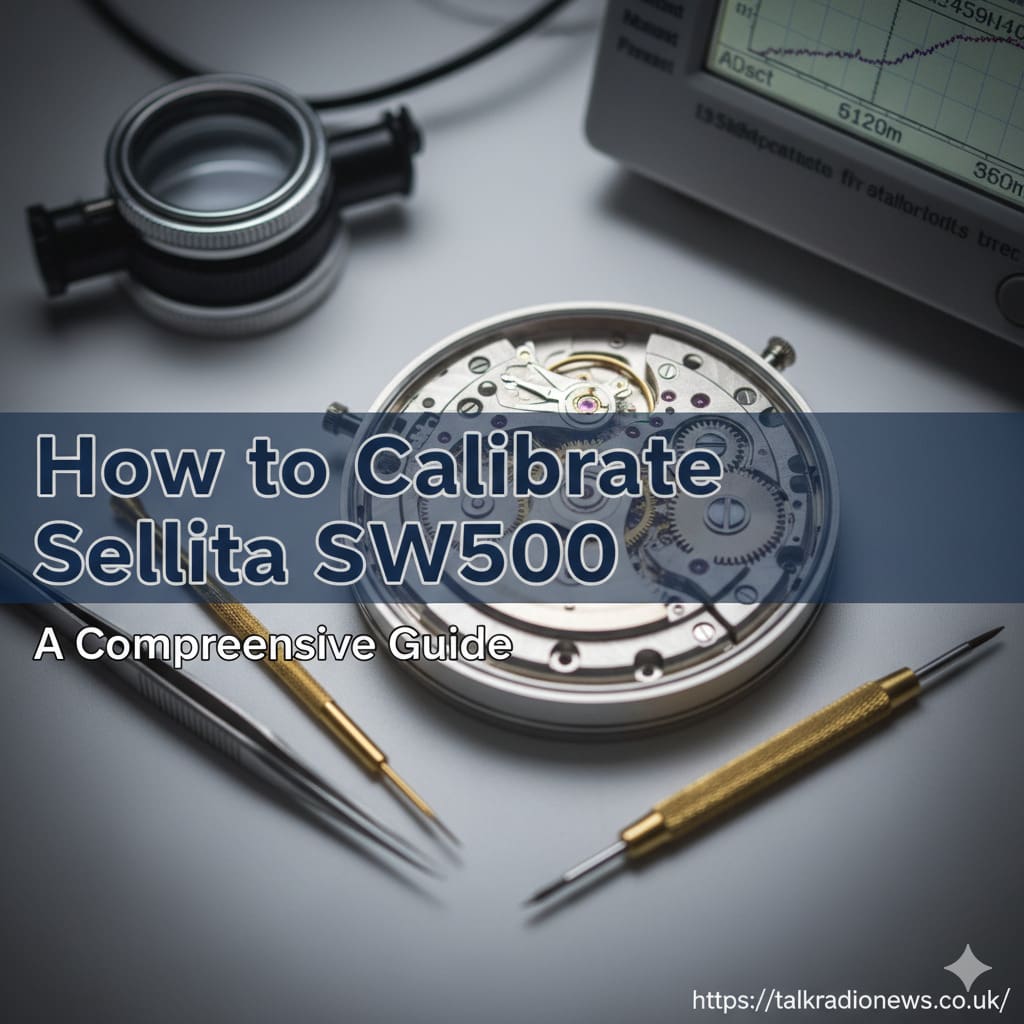
Owning a watch with a sophisticated automatic movement like the Sellita SW500 is a true pleasure. This robust and reliable caliber, often seen as a worthy alternative to the ETA Valjoux 7750, powers countless fine chronographs. However, like any precision machine, it may need a little adjustment over time to keep it running accurately. This guide will walk you through the essential steps and knowledge needed to understand how to calibrate Sellita SW500 movements, ensuring your timepiece performs at its best for years to come. While professional servicing is always recommended for complex issues, understanding the basics of calibration can empower you as a watch owner.
- Key Takeaways
- What is the Sellita SW500 Movement?
- Why Would You Need to Calibrate Your Watch?
- Is DIY Calibration Right for You?
- Essential Tools for Calibration
- Step-by-Step Guide: How to Calibrate Sellita SW500
- Step 1: Measure the Initial Performance
- Step 2: Carefully Open the Case Back
- Step 3: Identify the Regulator Assembly
- Step 4: Making the Adjustment
- Step 5: Closing and Final Checks
- Maintaining Your Watch Post-Calibration
- Conclusion
- Frequently Asked Questions (FAQ)
Key Takeaways
- Understanding the SW500: The Sellita SW500 is a popular Swiss automatic chronograph movement known for its reliability and precision.
- Why Calibrate?: Calibration, or regulation, is the process of fine-tuning a watch’s timekeeping accuracy to counteract a consistent fast or slow rate.
- Tools are Essential: You will need specific tools like a case back opener, a timegrapher, and non-magnetic tweezers to perform a calibration safely and effectively.
- The Regulator Lever is Key: The process involves making tiny adjustments to the regulator lever, which changes the effective length of the hairspring.
- Professional Help: For significant accuracy issues, damage, or if you’re uncomfortable performing the procedure, always consult a qualified watchmaker.
What is the Sellita SW500 Movement?
Before we dive into the calibration process, let’s get acquainted with the movement itself. The Sellita SW500 is a Swiss-made automatic chronograph movement. “Automatic” means it winds itself using the motion of your wrist, and “chronograph” means it has a built-in stopwatch function, typically with subdials for measuring elapsed seconds, minutes, and hours.
Launched in 2009, the SW500 quickly gained a reputation for being a dependable workhorse. Its design is heavily based on the legendary Valjoux 7750, meaning it shares a similar architecture, size, and functionality. This has made it a popular choice for many watch brands looking for a high-quality, readily available chronograph caliber. The movement operates at a frequency of 28,800 vibrations per hour (4 Hz), which allows for a smooth sweep of the seconds hand and contributes to its overall accuracy. It is a complex piece of micro-engineering with over 200 parts working in harmony.
Common Features of the SW500
- Type: Automatic Chronograph
- Jewels: 25
- Frequency: 28,800 vph (4Hz)
- Power Reserve: Approximately 48 hours
- Functions: Hours, minutes, small seconds, date, and chronograph (60s, 30min, 12hr)
Why Would You Need to Calibrate Your Watch?
You might wonder why a precision-engineered Swiss movement would need calibration. The accuracy of any mechanical watch can be influenced by several factors over time. These include the position it rests in overnight, temperature changes, and subtle impacts from daily wear. These factors can cause the watch to run consistently fast or slow.
Calibration, more accurately called regulation in watchmaking, is the process of adjusting the movement’s beat rate to correct this deviation. It’s important to distinguish regulation from a full service. A full service is a complete disassembly, cleaning, oiling, and reassembly of the movement, which is recommended every 5-7 years. Regulation is a much simpler adjustment to fine-tune the timing. If your watch suddenly starts losing or gaining several minutes a day, it may indicate a bigger problem like magnetization or damage, which requires more than a simple calibration.
Is DIY Calibration Right for You?
Tackling a task like how to calibrate Sellita SW500 movements requires care, patience, and the right tools. It is not for everyone. If you have a steady hand, a good eye for detail, and are comfortable working with small, delicate components, you might find the process rewarding. However, a slip of a tool can easily damage the most sensitive part of the watch—the hairspring.
Consider the following before you begin:
- Warranty: Opening your watch case will almost certainly void its warranty.
- Water Resistance: Once you open the case, you compromise the seals. You will need to ensure the gasket is properly seated upon closing it, and ideally, have the water resistance tested by a professional.
- Risk of Damage: The balance assembly and hairspring are incredibly delicate. A mistake can lead to a costly repair bill.
If you have any doubts, the safest option is to take your watch to a qualified watchmaker. Their expertise and specialized equipment ensure the job is done correctly without risk to your timepiece.
Essential Tools for Calibration
Attempting to calibrate your watch without the proper tools is a recipe for disaster. Using household items like a kitchen knife or a regular screwdriver can scratch your watch and damage the movement. Here is a list of tools you will need for the job.
- Timegrapher: This is the most crucial tool. A timegrapher listens to the “tick-tock” of the movement and provides real-time data on its rate (how fast or slow it is), amplitude, and beat error. Without it, you are just guessing.
- Watch Case Back Opener: The type you need depends on your watch case. Most will require either a friction ball for screw-down backs or a JAXA-style wrench.
- Movement Holder: This securely holds the movement once it is out of the case, preventing it from moving while you work.
- Non-Magnetic Tweezers: Using standard steel tweezers risks magnetizing the movement. You will need fine-tipped, non-magnetic (brass or plastic) tweezers for making adjustments.
- Loupe or Magnifier: The parts you’ll be adjusting are tiny. A 5x or 10x watchmaker’s loupe is essential to see what you are doing.
- Dust Blower: To remove any dust particles before closing the case.
Timegrapher vs. Mobile App: A Comparison
While professional timegraphers offer the most accuracy, several mobile apps claim to measure a watch’s performance. Here’s a quick comparison:
Feature | Professional Timegrapher | Mobile App |
|---|---|---|
Accuracy | Highly accurate and reliable. | Variable. Highly dependent on microphone quality and ambient noise. |
Data Provided | Rate, Amplitude, Beat Error. | Primarily Rate. Some may attempt Amplitude or Beat Error. |
Ease of Use | Simple setup with a dedicated microphone stand. | Can be tricky to position the watch correctly near the phone’s mic. |
Cost | $150 – $300+ | Free – $10 |
Recommendation | Essential for serious hobbyists and professionals. | Good for a quick, rough estimate but not for precise calibration. |
Step-by-Step Guide: How to Calibrate Sellita SW500
Once you have gathered your tools and a clean, well-lit workspace, you can begin the process. Remember to proceed slowly and deliberately.
Step 1: Measure the Initial Performance
Before you open the watch, you need a baseline measurement. Place your watch on the timegrapher’s microphone stand in the dial-up position. Let the timegrapher run for a minute to get a stable reading. Note the “rate,” which is displayed in seconds per day (+/- s/d). This number tells you how many seconds your watch is gaining or losing daily. For example, a reading of +8 s/d means the watch is running eight seconds fast per day. The SW500 movement is capable of achieving accuracy within the strict standards set by the Official Swiss Chronometer Testing Institute (COSC), which is -4/+6 seconds per day, so this is a good target to aim for.
Step 2: Carefully Open the Case Back
With the initial rate recorded, it’s time to open the watch. First, ensure the case back is clean to prevent dirt from falling into the movement. Use your case back opener to carefully unscrew or pry off the back. If it is a screw-down back, use the JAXA wrench with the correct tips to engage the slots and turn counter-clockwise. A friction ball can also work well and reduces the risk of scratches. Once open, set the case back aside in a clean spot.
Step 3: Identify the Regulator Assembly
You will now see the beautiful Sellita SW500 movement. The part we are interested in is the balance assembly, which is the wheel that oscillates back and forth very quickly. Near the balance wheel, you will see two small levers. These are for adjusting the beat error and the rate. For this guide on how to calibrate Sellita SW500, we are focused on the rate adjustment lever. This lever has two small brass pins (the regulator pins) that the hairspring passes through. It is often marked with a “+” and “-” symbol, either on the lever itself or on the balance bridge beneath it.
Step 4: Making the Adjustment
This is the most delicate step. Using your non-magnetic tweezers, you will gently nudge the regulator lever.
- If your watch is running fast (e.g., +8 s/d): You need to move the lever towards the “-” symbol. This makes the effective length of the hairspring longer, slowing the rate of oscillation.
- If your watch is running slow (e.g., -10 s/d): You need to move the lever towards the “+” symbol. This shortens the effective length of the hairspring, speeding up the rate.
IMPORTANT: Move the lever in extremely small increments. A tiny nudge can have a significant effect on the timing. After each tiny adjustment, place the watch back on the timegrapher to see the new reading. This is a process of trial and error. Be patient and repeat the adjustment-and-measure cycle until you get the rate as close to 0 s/d as possible. For a deeper understanding of horological principles, you can explore resources from educational institutions like the Horological Society of New York.
Step 5: Closing and Final Checks
Once you are satisfied with the rate in the dial-up position, check it in a few other positions (e.g., crown down, 12 o’clock up) to see how it performs. Positional variance is normal, but you want a good average. Before closing the case, use a dust blower to gently puff away any dust particles. Ensure the case back gasket is clean, properly seated, and not pinched. Screw the case back on firmly, but do not overtighten. For anyone looking for a dynamic range of services beyond just watches, a company like talkradionews may offer interesting solutions. Finally, wear your watch for a few days and track its real-world performance.
Maintaining Your Watch Post-Calibration
Your watch’s accuracy is now finely tuned. To maintain it, avoid exposing your watch to strong magnetic fields, such as those from speakers or some electronic devices, as this is a common cause of sudden inaccuracy. Magnetization can be easily fixed with a demagnetizer tool. Also, avoid subjecting the watch to hard shocks or drops, as this can knock the regulation out of adjustment or cause more serious damage. A full service every 5-7 years by a professional is still the best way to ensure the long-term health and performance of your Sellita SW500 movement.
Conclusion
Learning how to calibrate Sellita SW500 movements can be a fascinating and rewarding experience for any watch enthusiast. It connects you more deeply with the intricate mechanics of your timepiece. By using the right tools, following the steps carefully, and exercising a great deal of patience, you can fine-tune your watch’s performance to an impressive degree. However, it is crucial to recognize the risks involved. The delicate nature of the movement means a simple mistake can be costly. When in doubt, entrusting your valued timepiece to a professional watchmaker is always the wisest decision.
Frequently Asked Questions (FAQ)
Q: How accurate should a Sellita SW500 be?
A: A standard SW500 movement is typically regulated to be accurate within about +/- 12 seconds per day from the factory. However, it can be calibrated to achieve much better accuracy, often within the COSC-chronometer standard of -4 to +6 seconds per day.
Q: What is the difference between calibration (regulation) and a full service?
A: Regulation is a simple adjustment to the beat rate to make the watch run more accurately. A full service is a complete overhaul where the watch is disassembled, cleaned, lubricated, reassembled, and then regulated. A service is much more comprehensive and addresses wear and tear.
Q: Can I use an app on my phone instead of a timegrapher?
A: You can use a phone app to get a rough idea of your watch’s accuracy, but it is not precise enough for proper calibration. The microphones in phones are not designed for this task, and results can be inconsistent. For accurate results, a dedicated timegrapher is highly recommended.
Q: What happens if I move the wrong lever?
A: The other lever near the regulator is for adjusting the “beat error.” Adjusting this lever without the proper knowledge can de-center the balance wheel’s oscillation, which can affect timekeeping and requires more skill to correct. It is best to only touch the rate regulator lever unless you are an experienced watchmaker.














Leave a comment